Monday, April 11, 2011

Morocco 3: heading west

So far we had spent two nights at each accommodation, but now we turned towards the coast again and had single nights in two towns on the way to our final two night stop in Agadir.

We left the desert with regret, returning to Erfoud and the bus. From there, although we drove for most of the day, it was a long time before we were out of the arid zone. On the way we passed a very ancient underground canal system that still brings water from the mountains to the oases.


Ancient underground canals.
The cross-section at the bottom of the sign explains.

Each of those hummocks is a well down to the canal.

The end result.
Irrigated alfalfa, beans and date palms.

It was also much clearer and we had fine views of the High Atlas as we ran parallel to them on our way south to Ouarzazarte (try that with a mouthful of chips). We went through several Berber towns and stopped for wonderful fresh-squeezed orange juice from a guy who showed us a postcard he had received from appreciative Australian customers.

Ouarzazarte sits beside a very large artificial lake which provided us with a whole lot of new birds. It also has a very fine kasbah, but there was no time to explore!


Atlas snows, from the bus.

Another Berber town.
Note all the satellite dishes!

Roadside view.
Each tree has its own dam to conserve water.

Palm leaf camel.
Made in 30 secs by a lad who gave it to us, but asked for "une cadeau" in return.

Water at last!
The lake at Ouarzazarte.

The kasbah at Ouarzazarte.
(Out of the bus window: as close as we got!)

Desert kasbah?
Nope. Film set outside Ouarzazarte, Morocco's Hollywood.

The following day we stopped for lunch in a market town called Tazenakht which serves many surrounding villages. As we were eating on the street we could discretely watch the locals who had come in for the market, and they could (less discretely) check us out. It was hard (and impolite) to photograph people, but there was a wonderful range. I even saw one guy wearing a ceremonial dagger. There were donkeys and donkey carts, old vans with sheep in cages on top and people of all sorts. And a lot of dust!


Tazenahkt street scene.
Surreptitiously photographed.

Tazenahkt.
To market, to market....

Dusty street, Tazenahkt.

The next night's stop was in Taroundante where we stayed in a palace! This town has the best preserved city walls in all Morocco and our hotel began life as the palace of the local supremo, more or less built into the wall. Our room was amazing: it wasn't a room, but a suite on two levels with two bedrooms, two bathrooms and its own private roof garden. The only pity was that we only had about 12 hours to enjoy it. In the morning, rather than joining the birders on the roof trying to sort out the Pallid Swift from the Common Swift, we sneaked out and walked round part of the walls. We ducked into one of the gateways into the old town, but we weren't game to try to navigate our way back through the alleyways; mustn't keep the bus waiting.


Getting greener.
Heading west through the southern end of the Atlas.

The palace apartment in Taroundante.
We decided to sleep downstairs.

Taroundante apartment.
Entry way and stairs, inside the apartment.
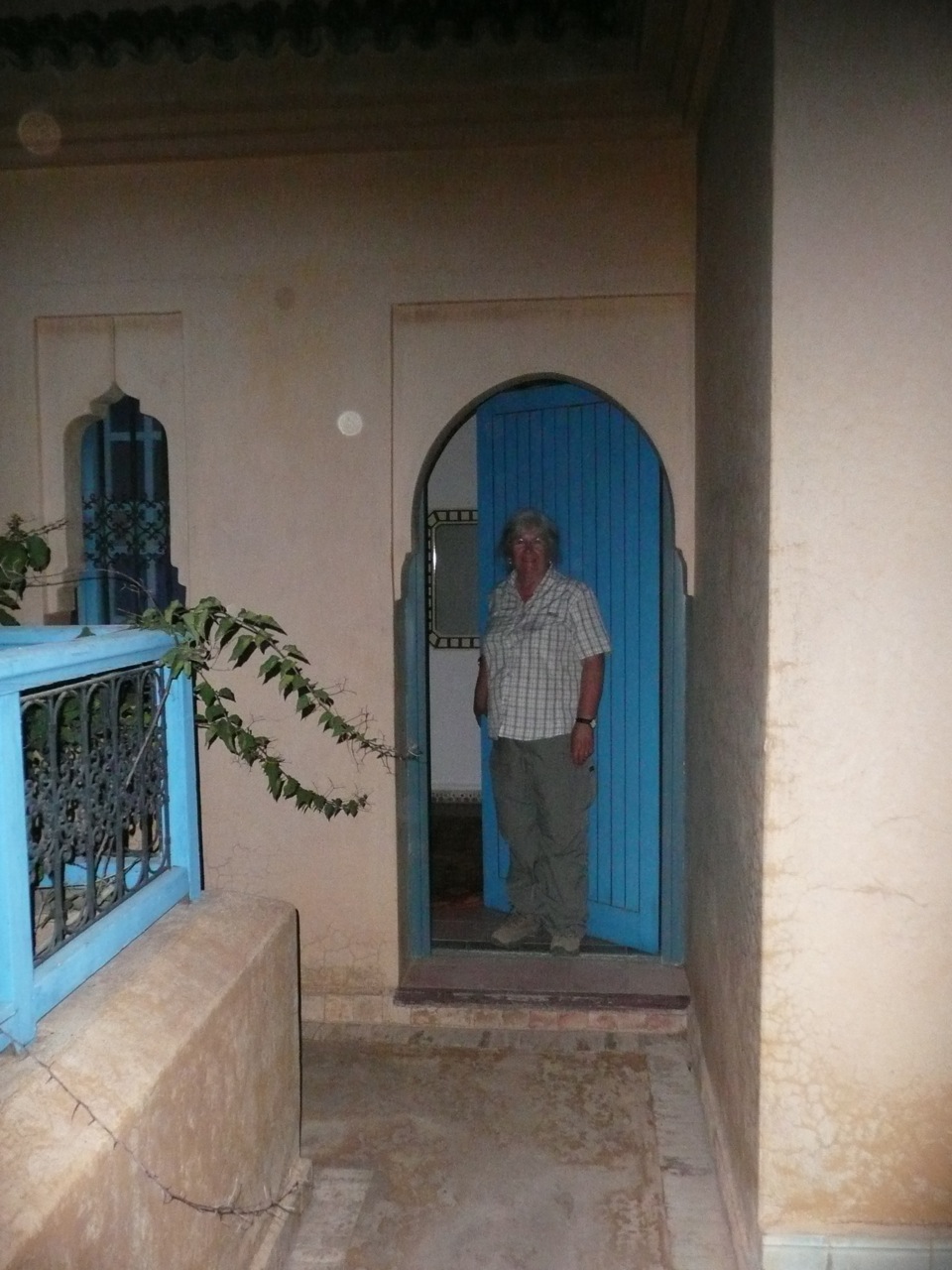
Our roof-top garden.

Part of the palace gardens.

Palace courtyard.

Palace door.

Early morning swift watchers: Common or Pallid?
The one on the left doesn't looked entirely rapt.

Taroundante city walls.
Complete circuit is a 1.5 hour walk.

Taroundante gateway.

On the road today we passed through Talouine, saffron capital of Morocco. They produce two and half tons of saffron every year and when you consider that one flower yields just three little stamens, that's an awful lot of flowers. We were able to buy saffron very cheaply at a local shop.


The saffron shop in Talouine.

Now, as we skirted round the southern end of the Atlas mountains the country was at last becoming better watered. We drove west down the Souss River valley into an intensively agricultural area. But the hills, and anywhere not cultivated, were dominated by the argan tree, in a landscape that reminded me of the Albert Namatjira paintings of the Flinders Ranges.


Argan trees in the upper Souss valley.

Argan trees.

Argan fruit.
Waiting for a hungry goat.

Intensive cropping in the Souss valley.
Never saw exactly what these were; mint perhaps (we drank a lot of mint tea).

Argan trees produced a hard fruit around a oil-bearing nut which is the basis of a vegetable oil industry. In the traditional way the fruit is eaten by goats, then the nuts are recovered from the goat droppings, crushed and pressed for the oil. A bit like that very expensive coffee that goes through the gut of some creature or other. It seems there are now more modern ways of extracting the oil, and it is on sale everywhere for both culinary and cosmetic purposes.


Shop selling argan oil products.

Agadir doesn't have much to commend it, unless you like large modern beachside cities. That's because the whole place was flattened by an earthquake in 1960 from which only one building survived. We were there for the Bald Ibis, a bird badly in need of friends, but with few natural advantages. It only survives in two small colonies on the coast, which no one is allowed to visit, but the birds turn up for a midday drink at an estuary nearby, and we saw them, at least in the distance.

The Bald Ibis beach, north of Agadir.

Some tasty surf around Agadir.

We also wanted to visit the mouth of the Souss estuary, but it borders on a very posh golf course where an international competition was being played, and despite three attempts we could not persuade the security guards to allow a motley crew, some in camouflage gear, armed with high-powered telescopes into the restricted area. Funny, that.

Our last day took us south to the Massa estuary. This is effectively the last river for a very long way south along the west African coast, so it is an important staging post for migrant birds as they fly between southern Africa and Europe.


Massa River, south of Agadir.

Succulent vegetation in the Massa National Park.

And so our Moroccan adventure drew to a close. We saw so much and thanks to the birds we were able to get out into the wild and taste it, which you can't do through the windows of a vehicle. It would have been good to have also been able to "taste" the towns a bit more, but that will have to wait for another time.

Saturday, April 9, 2011

Morocco 2: the desert

We had two nights in Marrakesh, but then we set off eastwards towards the mountains and beyond. But first we had to get out of town, and that was a slow business because there had been some sort of major flood that jammed all the traffic, but provided plenty of opportunities for watching the people.
Traffic in Marrakesh.
There was mud everywhere.

The road across the mountains was amazing: hairpin after hairpin, so that all the time we could look back to see, down below, where we had come from. We reached the pass at 2500m, where we had lunch and then started to descend. But we didn't go down very far, since the desert plains start at well over 1000m asl. As expected it got much drier as we travelled east, but there were surprises: there are several quite large towns and places (oases, I guess) where irrigation, or a natural water supply, allowed plantings of date palms, with the ubiquitous alfalfa and beans in between.


The Tichka Pass.
Not at the top yet!

Top of the Tichka pass.
And our lunch spot

The Ziz valley.
Amazing oasis, unseen in the barren lands until we were right at the edge.

Our first destination was Boumalne de Dades, a Berber town on the edge of the hamada, ie the pebble desert that covers most of the area (sand dunes come later). Our hotel was perched over the town, so that the call to prayer started the waking process at 5.00, since we had a pre-breakfast expedition into the desert to see some of the specialities, such as coursers and sand grouse. As well as the birds, many ground squirrels and fat-tailed desert rats live in the area, and the sand between the pebbles is a records of the previous night's activities.


Boumalne de Dades.
So many mud brick towns like this.

Boumalne from our window.

Dawn in the desert.
High Atlas behind.

Road to nowhere?
Pity the driver who has birders on board.

What happened last night?
Tracks in the sand.

Darkling Beetle.
One of the track-makers.

We call it "desert" but for the locals this is just the landscape in which they live, and as our eyes became accustomed we began to see that there were people all over the place. Most were shepherds, with a flock of sheep and goats, but we also saw people gathering fuel and forage, and a group of nomads who were on their way into town after what was probably a walk of several days from the outer parts of the desert. We met two Berber women on their way back to their camp (in caves in a dry wadi) with big bales of fodder; they were curious but not game to accept an invitation to look down the telescope of a male birder. But when Jean and one of the other ladies met them alone they were very happy to see the binoculars and one of them suggested (jocularly, I guess) that Jean should let her keep them.


Berber nomads.
Too shy to look down the 'scope.


On another occasion we ran into a very large flock (they disturbed our sand grouse before we got to see them) minded by three heavily veiled women. They came over to see what we were doing and asked us for water, so it was a privilege to transfer the contents of my water bottle into the two litre plastic bottle of one of the women, which was carefully sheathed and carried around her waist. There were no effusive thanks, just a nod of acknowledgment.


Berber camp in a dry wadi.
The building on the horizon was our hotel!


The Berber people are the original inhabitants here, but they are intermixed with African people from the south and arabs from the north. They speak their own language, but Arabic, and to a lesser extend French, is the universal language. We descended, unannounced on a very small roadside cafe in one town where we simply wanted to eat our picnic, but the owner told us in broken English that "I am Berber, you are welcome, no problem!" and proceeded to go to some trouble to produce tables and chairs. Needless to say we were careful to buy food and drink to make it worth his while, but his welcome was genuine. On another occasion we met a couple of boys who came to see what we were doing, one of whom spoke good English and wanted to practice it. When I asked whether he spoke Berber at home he was a mite scornful, so perhaps there is a little Berber-Arab tension. Certainly the Berbers were a thorn in the side of the French administration well into the mid-twentieth century.

After two nights at Boumalne, we drove to Erfoud, fossil capital of Morocco (but we didn't get to see the good stuff, I'm afraid) and transfered to 4WD vehicles to reach our outermost stop, an auberge at Derkaoua on the edge of the Erg Chebbi dunefield. This place was established by a Frenchman and is a delightful walled complex of mud brick buildings with little courtyards, pools and outdoor dining. We spent two nights there, and in the day in between our 4WDs took us along the edge of the dune field (skirting some settlements which began life as sets for Lawrence of Arabia!) to a remote spot where we met up with a local nomad who was to guide us to see some desert specialities.


Desert driving.
Spread out to minimise the impact, and the dust.

The auberge at Derkaoua.

Midday at the oasis.
Welcome break after an early start.

They're out there somewhere.

Chilly in the early morning.
Not paying attention at the back!

Top of the list was the Houbara Bustard, a bird that has so much significance for some Arabs that it has become severely depleted. The Saudi royal family fly into Morocco to hunt these birds in the traditional way, with falcons. They do at least put quite a lot of money into a breeding program at several sites in Morocco, but it was sad to learn when we did get to see one of the birds that it was the sole survivor of a group that has been whittled down by Saudi hunters.

Another sad thing was to see young boys at the side of the road holding up animals for tourists to photograph. One of these was the "sand fish", a lizard that spends most of its time under the sand dunes, but the worst was a fennec fox, a charming animal that I have always wanted to meet, but not squirming in the arms of a boy, with a collar of blue plastic twine round its neck. We could have bought it and released it, but a) it probably would not survive and b) it does no good at all to encourage these boys (hence no photo).

Having shown us the bustard, and an Egyptian nightjar, in the middle of nowhere, we dropped our nomad off, and he just headed off on foot, who knows where to. Humbling to see that people survive in that environment, where the temperatures were already in the high 30s, in what was still only spring.

But altogether, the desert was an amazing experience and I've barely done it justice.

What's that? Camels?
Oh yes, there were camels.

Camels at Erg Chebbi.
These looked more natural, but they are all domesticated.


Tuesday, April 5, 2011

Morocco 1: Marrakesh and the High Atlas

I'm not sure that it is altogether a Good Thing to be able to move from the burning sands of the Sahara to the cool grey dampness of a Cornish spring in such a short time, but here we are, enjoying a catching-up day in our self-catering "studio", more of which anon. We've just returned from 11 days in Morocco and all the experiences are still spinning round in our heads, but I will try to distill them in a post or three.

Our trip was arranged by Travelling Naturalist, a UK company that we used before, in Iceland. The tour was called "Spring in Morocco", but it quickly became apparent that it was a serious birding trip for most of the participants, who were keen to add various Moroccan specialities to their personal lists. This wasn't a problem for us, since we like to look at birds too, even if we don't keep a "Life List"; a tour like this takes us to places that we wouldn't find under our own steam and there was certainly plenty to entertain us while others were trying to sort out the Western Olivaceous Warbler from the Eastern Olivaceous Warbler.

The trip fell into three parts, the High Atlas, the desert and the Souss valley, so I'll probably do the posts that way, with general comments about that wonderful country and its lovely people as we go along.

Morocco, simply drawn.
We started in Marrakesh, west of the mountains, then Boumalne, Derkaoua, Ouarzazarte, Taroudannt and Agadir.

We flew from London to Marrakesh via Casablanca with Royal Air Maroc, arriving late in the evening and finding (to my relief) that our transport was to be a reasonably large bus, not the minibuses that I had feared (cramped, little luggage space, competition for best seats). The hotel was a tourist place in the nouvelle ville, some distance from the old centre of Marrakesh, but the patch of waste ground opposite was enough to get the birders out early, collecting new species.

Marrakesh hotel, where it all started.
Our bus wasn't as big as that one.

The first day took us more or less east up the Ourika valley into the High Atlas. I confess that hadn't realised how high, and how extensive, the Atlas Mountains are. It was hazy as we left Marrakesh, so it was a surprise when snow-covered peaks emerged ahead of us. We drove up the valley on increasingly narrow and winding roads getting higher and higher until we reached the ski resort of Oukaimeden, one of very few ski resorts in Africa (and I had to keep reminding myself that we really were in Africa). Here we were at the snow line and the highest peaks in the range were all around us.


The High Atlas.
Fabulous scenery.

The only African ski-field? Oukaimeden.
And those are Crimson-winged Finches on the sign (You knew that, didn't you?).

But this wasn't your average coach tour. You must imagine it punctuated at frequent intervals by cries of "raptor flying right at two o'clock!) and the bus stopping as quickly as possible. The leader, Arnoud van der Berg, is a gun birder with an amazing ability not only to see very small birds from inside a bus, but even to hear them! So our stops were rarely chosen for their aesthetic qualities and we often found ourselves dodging passing traffic while scouring the bushes for a bird.

Roadside birders.
And Rachid waiting patiently in the bus.

And not much of this was happening in the wilderness. Only at the very highest altitudes were there no local people; everywhere else there were Berber villages of mud bricks, apparently growing out of the landscape, many seen across valleys with no road access at all. The first impression was of the pictures I've seen of Afganistan, or even Tibet. There were foot tracks everywhere, and as we looked around we started to see people all over, walking on tracks, gathering fuel and forage for animals, or cultivating tiny terraced fields of alfalfa, barley, beans and fruit and nut trees.

Berber villages in the Ourika valley.
Yes, more than one. Look across the valley.

And wherever we stopped people appeared almost instantaneously to see whether we were interested in buying necklaces, minerals, fossils, scarves etc. Stalls were set up at the more frequently used stopping places, but there were many mobile opportunists on little motorbikes who were prepared to pursue a bus like ours for some distance. After my experiences in Tunis I was not looking forward to the attentions of these salesmen, but in Morocco it seems that a polite but firm "no thank you" (or rather "Je regret, mais non", since French is widely spoken) was always respected.

Roadside stall.
So many tagines for sale, but not suitable for our hand luggage.

Other people, mostly small boys, also turned up out of sheer curiosity. We saw several other birding groups as we travelled, but the phenomenon of adults spending a long time peering at something apparently invisible through very expensive optics is clearly still a novelty. One old man enjoying the sun outside his house watched us for a long time as we tried to locate Levaillant's Woodpecker in the nearby trees, then smiled and tapped his forehead. Amusement or bewilderment was the common response, but one group of young men in car blew the horn and shouted "Vous etes fou!". But generally everyone was friendly and many waved spontaneously as we drove past. Any eye contact or wave from our end was always met with a wave, even from women bent double under huge bales of fodder. The kids waved enthusiastically, and when I made faces they went into hysterics.

We returned to the hotel in Marrakesh, and although we'd had a long day we accepted an offer from the bus driver (Rachid, what a star) and Arnoud for a visit to the main square in the old town. Diemma El-Fna is a very large open square in front of the main mosque that fills up every night with food stalls, musicians, story-tellers, conjurors etc etc. It borders on the souks which are open at all hours, selling just about everything. We did a circuit of the square and a cautious loop into the souks (easy to get lost) and noted that les than 10% of the crowd were tourists, the rest all locals, of all ages.

Diemma El-Fna, Marrakesh.
Can't share the noises and smells, I'm afraid.

Our first day in Morocco was a mass of new experiences, but it all suggested that we were in for a great trip.

Thursday, March 24, 2011

A Stroll in the Country


I think I said before how well this country is supplied with places to walk. Despite the very busy roads there is a multitude of public footpaths, bridleways and lanes through the fields from village to village.

The village of Odell, Bedfordshire.
The wood we walked in is on the ridge.

Today Ruth dropped us in the neighbouring village of Odell, only a few miles away as the crow flies, but a bit of a loop in the car because of the wandering River Great Ouse. At Odell there is a large patch of woodland, mostly old oak trees with an understorey of coppiced hazels. In a few weeks there will be a carpet of bluebells as well, but right now the flowers are mostly primroses and celandines. The trees are just beginning to come into leaf, but the open woods are great for bird watching.

Odell Great Wood.

Track in Odell Great Wood.

We strolled through the woods for a couple of hours, then returned to The Ball at Odell, for a baguette and pint of the local ale, and the weather was certainly good enough to eat it outside in the garden.

The Bell at Odell.

Pub lunch in Odell.
Note the hearty pint of ale, and the bird book.

Then we crossed the river at the site of the old mill and returned to Pavenham, only having to cross one back road. Nine or so kilometres, and all very pleasant.

Mill pond on the River Great Ouse.
Oozing along quite quickly, really.

I know my limited readership is keen to see a few shots of Heron House and its inhabitants, so here they are!

Bowers Towers, Pavenham.
aka Heron House.

Jean and Ruth.
Two respectable ladies of late middle age.......

....but still capable of acting the fool occasionally!